
The Trump Administration Wants To Take Greater Control Of Scientific Grants. Here’s Why That’s A Terrible Idea.
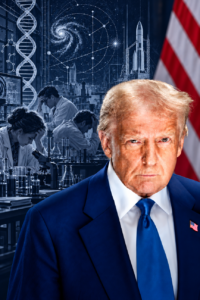
Since World War II, the United States has dominated science and technology. With more than 400 Nobel Prizes, it dwarfs every other country. Major breakthroughs like nuclear energy, genetic engineering and the Internet were all led by researchers and engineers in the US. Today, it leads in every major technological category.
To a great extent, this has been the result of government action. Federal agencies such as the NIH, NSF and DARPA spearheaded many of the most advanced technologies, and US research universities have become beacons for top scientific talent. These advances have brought us greater prosperity, better health and well-being.
That’s why the recent news of an executive order giving political oversight to scientific grants provoked such an uproar. Although the administration quickly backed off, the incident represents a troubling trend of political interference in science that has led to a major brain drain of scientific talent. Without a major change in course, the damage will be permanent.
Science, The Endless Frontier
America wasn’t always a scientific mecca. In fact, at the beginning of the twentieth century, bright young students often had to go to Europe to pursue advanced degrees in the sciences, because American universities were considered second-rate. Yet as the US industrialized, that began to change and, by the 1930s, with Europe increasingly in turmoil, world-class scientific talent began to flock to American shores.
In 1940, Vannevar Bush, who was serving as president of the Carnegie Institution for Science, went to see President Roosevelt. His proposal led to the establishment of the Office of Scientific Research and Development (OSRD, which mobilized the country’s scientific resources for World War II. It was a resounding success, resulting in breakthroughs such as radar, penicillin, the proximity fuse and, most famously, the atomic bomb.
As the war was winding down, Roosevelt asked Bush to write a report proposing how America could continue the success of the OSRD in peacetime. That report, Science, The Endless Frontier, was delivered to President Truman in 1945 and would set the stage for America’s technological dominance during the second half of the century. He wrote:
Basic research leads to new knowledge. It provides scientific capital. It creates the fund from which the practical applications of knowledge must be drawn. New products and new processes do not appear full-grown. They are founded on new principles and new conceptions, which in turn are painstakingly developed by research in the purest realms of science.
It was that vision that led to US technological dominance. Look at any major technology we use today, whether it is the Internet, GPS, or lithium-ion batteries, and the initial breakthrough came from government funding. A study from the Institute for New Economic Thinking found that every new drug approved between 2010 and 2019 benefited from government grants. Even major private firms, such as Google and Qualcomm, started out with government funding.
A key tenet of that vision is that decisions about research grants need to be made by scientists, not political appointees, so that we are funding scientific, not political priorities. That principle is what has come under threat.
The Visceral Abstract
There is a long history of politicians being hostile to science. In a 2012 interview, Marco Rubio, then a senator and now Secretary of State, said that the age of the universe and the Big Bang “has zero to do with how our economy is going to grow.” Former Vice President Mike Pence expressed doubts about Darwin’s theory of natural selection. Paul Broun, a congressman, called it, “lies straight from the pit of hell.”
Yet the Big Bang is not just a theory, but the result of a set of theories, including general relativity and quantum mechanics, combined with observations over a period of decades. Darwin’s theory is core to our understanding of life sciences. Students learn about these things not to shape their religious beliefs, but because they underlie basic scientific work.
Politicians attack science because it’s an easy target. It’s not hard for the public to imagine that their tax dollars are funding overeducated elites thinking up wacky theories in ivory-tower institutions. Scientific theories take time and effort to understand and can be maddeningly difficult to explain.
The truth is that we live in a world of the visceral abstract, where strange theories underlie much of our everyday existence. Technologies that we use every day, such as the lasers that scan our purchases in the checkout aisle and the semiconductors that drive our devices, arose from these same strange ideas. Darwin’s theory underlies everything from fighting diseases like COVID-19 to guiding logistics systems.
If we are to master the advanced technologies of the future, such as quantum computing, synthetic biology and materials science, we need to master the scientific theories that will drive them.
The Tragedy Of Trofim Lysenko
While Vannevar Bush showed what can be achieved when a government invests in science as a public good, Trofim Lysenko showed what happens when science is politicized. A Soviet agronomist who considered the concept of a gene to be a “bourgeois invention,” he, like Pence and Broun, was skeptical of Darwin’s theories.
Yet he was able to get Stalin to support his ideas, such as his theory that exposing seeds to low temperatures will help them grow in the winter. These were mainly based on political expediency and personal belief, not empirical evidence. He promised miracle crop yields that never materialized, but his power allowed him to suppress legitimate scientists.
The effect on Soviet science was chilling. Anybody reporting results that went askew of Lysenko’s theories risked not only professional suicide, but in many cases imprisonment and even execution. To adopt “bourgeois” science was not just to have a different idea, but was to be branded an “enemy of the people” working to undermine the Soviet project.
Meanwhile, those who went along with Lysenko’s program gained authority. Competency in Soviet biological sciences diminished greatly. Crop yields steadily declined throughout the late 1930s until his downfall in the mid-1960s. Many believe that his theories contributed to the Great Famine in China.
If Nothing Is True, Everything Is Possible
One thing that struck me during the 15 years I lived in post-Communist countries was how problems seemed to build on themselves. In Kraków, the abandoned frame of the Szkieletor building stood frozen for decades. Construction had stalled in the 1970s, so the frame just stood there rusting. It became almost a metaphor for the Soviet space as a whole.
In a healthy society with checks and balances, someone would have been held to account. There would have been litigation. A court would have mandated a cleanup. But in a command economy, power flows from a single source, with no one to hold it accountable. Those in power don’t have to admit their mistakes. Questions of truth become questions of loyalty.
We have a similar process underway in the US. When politicians and unelected bureaucrats seek to make scientific funding conform to their ideological preferences, they are not merely making budget allocations. They are seeking to control what is true and what is not. We’ve seen that enough times before to know how it ends.
America achieved technological dominance, in part, because of the scientists who fled Europe to escape similar populist tyranny. Now that process is reversing, with scientists leaving America for Europe. The advantages we built after World War II are quickly eroding, threatening our prosperity and security.
That’s why we don’t want politicians running science. It diminishes science and leaves us with only politics.
Greg Satell is Co-Founder of ChangeOS, a transformation & change advisory, a lecturer at Wharton, an international keynote speaker, bestselling author of Cascades: How to Create a Movement that Drives Transformational Change and Mapping Innovation, as well as over 50 articles in Harvard Business Review. You can learn more about Greg on his website, GregSatell.com, watch his YouTube Channel and connect on LinkedIn.
Like this article? Join thousands of changemakers and sign up to receive weekly insights from Greg’s DigitalTonto newsletter!
Image generated by ChatGPT


