
The Cockroach Movement Is Shaking Up India. Here’s What Every Leader Needs to Learn:
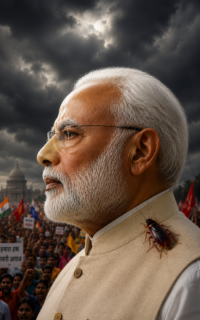
Narendra Modi is one of the most powerful leaders in the world. Domestically popular and internationally influential, his government has long appeared almost unassailable. Recently, however, that aura of invincibility has begun to crack. Massive protests, led by the Cockroach Janta Party, forced his education minister to resign
We’ve seen this before. In the early 2000s, color revolutions in Eastern Europe brought down powerful regimes in Serbia, Georgia and Ukraine. Soon after, the Arab Spring toppled governments across the Middle East. Business leaders face similar challenges, from campaigns over Nike’s labor practices to more recent uprisings against data centers.
As I explained in Cascades, these movements start small and then seem to explode all at once, in what network scientists call an instantaneous phase transition. Usually, by the time leaders notice them, it’s already too late. Yet these movements all have a common structure and, once you understand how they function, you can respond to threats more effectively.
Every Revolution Inspires Its Own Counterrevolution
People tend to see things in linear terms, so once a regime becomes dominant, as Modi’s has in India, we expect it to grow stronger over time. Yet as Saul Alinsky observed in Rules for Radicals, every revolution inspires its own counterrevolution. The exercise of power itself sows the seeds for resistance, which is why so many movements fail to survive victory.
That appears to be what happened in India. The Modi administration has been widely seen as successful and enjoyed high approval ratings. Yet power also breeds resentment, especially when people come to believe that its rewards are being reserved for insiders. In India, many came to suspect that those in high positions were abusing their power to enrich themselves and create favorable conditions for their family members.
Leaders need to keep this in mind. Famous failures, often start out looking like great successes. Enron revolutionized and then dominated energy trading, but that incredible success bred the hubris that led to its downfall. Blockbuster had gained an edge over Netflix before backlash from franchisees and stockholders undermined its transformation.
What’s key to understand is that the failure to survive victory is almost always a failure to project shared values, usually in favor of differentiating values that allow leaders to signal a preferred identity. So they tout things like “disruption” and “innovation,” or, in Modi’s case, Hindu cultural nationalism, but fail to show stakeholders where they fit in the future that is being built.
It’s an easy trap to fall into. It feels good to emphasize what makes us different. High-achieving people are motivated by setting themselves apart. But if you want to build a movement that endures, you need to create a shared identity forged in shared values.
How A Network Cascade Is Triggered
There’s a famous passage in Ernest Hemingway’s 1925 novel, The Sun Also Rises, in which a character is asked how he went bankrupt. “Two ways,” he answers. “Gradually, then suddenly.” The quote has since become emblematic of how a crisis takes shape. First with small signs you hardly notice and then with shocking impact.
This is related to what mathematician Benoit Mandelbrot called Noah effects and Joseph effects. Joseph effects, named for the biblical story in which seven years of plenty are followed by seven years of famine, describe how patterns persist and reinforce themselves over time. The Noah effect, as in the story of the famous ark, describes the opposite, a sudden shock that sweeps away the established order.
Regimes like Modi’s thrive on Joseph effects. They build up a regular rhythm that reinforces the status quo. Yet tensions brew beneath the surface. These take root in small, disaffected groups, such as the Committees of Correspondence that formed in the run-up to the American Revolution or the student group Otpor that originated the color revolutions.
It is this pattern of small groups, loosely connected, but united by a shared purpose, that sets the stage for a cascade. An external trigger, such as the shots fired at Lexington and Concord, an attempt to steal an election or, as in the case of the Indian Cockroach Movement, a leaked medical entrance exam, can then push the system past its tipping point.
At that point, what had been isolated pockets of resistance suddenly link together and spread across the network, gaining momentum as they go. Seemingly out of nowhere, what appeared to be small murmurs of discontent coalesce into a massive movement.
The Crucial Role Institutions Play
A cascade is, of course, no guarantee of success. Many massive movements, such as #Occupy and Turkey’s Gezi Park protests, triggered large cascades, bringing vast numbers of people into the streets, but never achieved significant goals. Others, such as the movement for LGBTQ rights, moved much more slowly but achieved far more.
The key difference is institutions, or what Gene Sharp called the Pillars of Support. There are sources of power that support the status quo, and these have an institutional basis. As long as they remain in place, the forces of continuity will prevail. But once they shift, anything becomes possible. Institutions give a movement what a viral cascade alone cannot: legitimacy, resources, access and the capacity to sustain pressure over time.
Again, we see the pattern repeat in India, with the Cockroach Janta Party gaining support from student and youth organizations, while opposition parties such as the Indian National Congress, Samajwadi Party and the Trinamool Congress amplified its demands. The crucial shift came when the government began negotiating with the movement and ultimately accepted its demands regarding examination reform and the treatment of protesters.
Business leaders need to take note. Consider the Nike sweatshop scandal in the 1990s. At first the company was defiant and tried the usual communication-driven strategies of denial and deflection. Yet ultimately, it realized that it was just fanning the flames of outrage. Things began to change when it took a more institutional approach, engaging with regulators and NGOs and helping to establish the Fair Labor Association to monitor labor practices.
In Net Positive, Andrew Winston and Paul Polman note that corporations that actively engage with stakeholder institutions on environmental and social governance tend to have far fewer problems, which leads to better corporate performance. You cannot defeat a cascade through messaging alone.
Learning To Shape Networks
In a classic Harvard Business Review article, Abraham Zaleznik contrasted two very different styles of authority. Managers, he argued, take a formal approach and seek order and control. Leaders, on the other hand, are more emotionally driven and seek to drive change. Put another way, managers work through hierarchies, while leaders shape networks.
Every organization needs both. Managers provide the continuity needed to execute efficiently, and leaders create the energy and connections necessary to respond dynamically to the needs of the marketplace. The best leaders learn to manage both hierarchies and networks, and the recent Cockroach protests in India illustrate how challenging that can be.
As prime minister, Narendra Modi presides over an enormous regime, and any flaw in governance, such as the leaking of a medical exam, exposes him to attacks. At the same time, he needs to actively engage with institutional networks beyond his formal control, including student organizations, civil-society groups and opposition political parties.
In Team of Teams, General Stanley McChrystal wrote that “the role of the leader was no more that of controlling puppet master, but of an empathetic crafter of culture.” We can no longer rely on authority conferred by hierarchies. The problem is not that they have suddenly become illegitimate, but that they are slow and the world has become fast.
That’s the lesson leaders need to learn from the Cockroach Movement. You can formulate viable strategies and execute them well, but if you aren’t actively shaping and engaging with informal networks, you will leave yourself vulnerable to a cascade. In the end, leaders are rarely undone by the hierarchies they control, but by the networks they ignore.
Greg Satell is Co-Founder of ChangeOS, a transformation & change advisory, a lecturer at Wharton, an international keynote speaker, host of the Changemaker Mindset podcast, bestselling author of Cascades: How to Create a Movement that Drives Transformational Change and Mapping Innovation, as well as over 50 articles in Harvard Business Review. You can learn more about Greg on his website, GregSatell.com, watch his YouTube Channel and connect on LinkedIn.
Like this article? Join thousands of changemakers and sign up to receive weekly insights from Greg’s DigitalTonto newsletter!
Image generated by Chat GPT


