The legendary physicist Max Planck once said, “A new scientific truth does not triumph by convincing its opponents and making them see the light, but rather because its opponents eventually die, and a new generation grows up that is familiar with it.” That may be a bit extreme, but the point still stands.
The status quo always has inertia on its side and never yields its power gracefully. To bring genuine change about, you not only have to point the way to a new and better reality, you also need to displace what people already know and are comfortable with. To do that, you’ll need to overcome resistance, both rational and irrational.
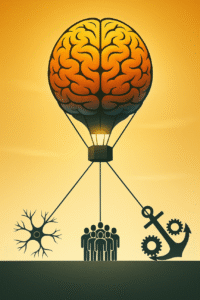
More specifically, you’ll need to overcome three forces that uphold the status quo: pathways that shape our default thinking, the cultural norms that perpetuate familiar behaviors, and the economic structures that resist disruption. To create real transformation, leaders must help people unlearn entrenched assumptions and rewire the forces that keep them stuck.
Gene Sharp lived most of his life as a relatively obscure academic. He wrote scholarly books that few read and gave lectures that few attended. His idea, that nonviolence could prevail over the most brutal dictators, seemed quixotic at best. While he gained a small cult following, he remained mostly unknown, even in scholarly foreign policy circles.
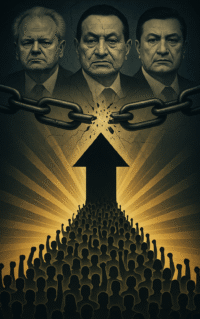
But then a group of young activists used his ideas to overthrow the Serbian strongman Slobodan Milošević. That led to an award-winning documentary narrated by Martin Sheen, which inspired activists in Georgia and then Ukraine to reach out. The Serbians trained them in Sharp’s methods, which led to the Rose Revolution and Orange Revolution, respectively.
Today, a quarter century later, Sharp’s methods have been successfully applied in more than 50 countries. I saw their power firsthand in Ukraine, and that experience inspired me to write Cascades, which showed how these same principles can be leveraged for organizational transformation. You can learn them too and put them into practice in your own life and work.
Yet it was Rogers who shaped our understanding of how ideas spread. Publishing more than 30 books and 500 articles, he studied everything from technology adoption to family planning in remote societies and just about everything in between. In doing so, he laid the foundation for an evidence-based approach to change.
Still, while Rogers showed us how change works, he didn’t offer much insight into why it works that way. This is where Michael Morris’s book Tribal can be helpful. By exploring how our tribal instincts lead us to adopt—or resist—change, we can learn to work with human nature rather than against it. Smart leaders don’t try to override instinct. They harness it.
When Peter Drucker first met IBM CEO Thomas J. Watson in the 1930s, the legendary management thinker was somewhat baffled. “He began talking about something called data processing,” Drucker recalled, “and it made absolutely no sense to me. I took it back and told my editor, and he said that Watson was a nut, and threw the interview away.”
Things that change the world always arrive out of context for the simple reason that the world hasn’t changed yet. So we always struggle to see how things will look in the future. Visionaries vie for our attention, arguing for their theory of how things will fit together and impact our lives. Billions of dollars are bet on those competing claims.
This is especially true today, with AI making head-spinning advances. But we also need to ask: What if the future looked exactly like the past? Clearly, there’s been big innovations since Drucker met Watson. How did those technologies impact the economy and shape our lives? If we want to know what to expect from the future, that’s where we should start.
In March 2024, Bill Anderson, pharma giant Bayer’s CEO, wrote an op-ed in Fortune vowing to bust bureaucracy, slash red tape, and eliminate layers of middle management to create a more agile and innovative enterprise. “Our radical reinvention will liberate our people while cutting 2 billion euros in annual costs by 2026,” he wrote.
I wrote soon after that what Anderson was doing wasn’t genuine transformation but had all the telltale signs of transformation theater: a false sense of urgency calling for drastic action, a rushed strategic process, with little or no time for analysis or dissent, and a large, premature public rollout to generate publicity for the effort.
Today, more than a year later, Bayer’s stock remains near all-time lows. Investors are increasingly frustrated and it’s not hard to see why. He went into an organization that was already reeling and introduced even more stress and disruption, with predictable results. If you want to create genuine transformation, you need to start by creating a sense of safety.
Years ago, we had a manager named Ania running one of our publishing operations. She was well-liked, diligent, and responsible. Still, we felt the business needed a more creative spark, so we brought in a rising executive to take her place. Ania transitioned out gracefully and left the company on good terms.
Things turned out well. Our business thrived and Ania became a sought-after interior decorator, renowned for her creativity. The problem wasn’t that she lacked any creative ability. The problem was that we weren’t giving her the type of challenges that excited her. While she languished in our organization, she excelled in a different environment.
The truth is that there is no such thing as a “creative personality.” Leaders set the conditions for the people to be creative. But as you set those conditions, you also narrow possibilities, making the environment fertile ground for some, but barren for others. Every leader needs to build the discipline to make those choices. Culture matters. You need to shape it with care.
I still remember feeling a bit awed when I first arrived in Ukraine in 2002. I had already spent five years in the region, so I was no stranger to Eastern Europe or to post-communist societies. Yet Kyiv was different. It was much larger than other regional capitals, like Warsaw, Prague, or Budapest, and it carried an air of what felt like destiny.
Still, Ukraine was a cynical place. Corruption was endemic. There was little civic discourse, and almost no appetite for political or social mobilization. The prevailing attitude was, “Nothing will ever change, so why bother thinking about it? Just do your job, take care of your family, and maybe save enough for a decent vacation every now and then.”
Today, Ukraine has been utterly transformed to an extent very few thought possible. And it’s worth looking back to understand how it underwent such a profound shift. Because if change can happen in Ukraine, where everything once seemed so completely hopeless, then there is no limit to how we can impact the world. That is something truly worth exploring.
People become leaders by first becoming effective managers. They create cohesion and consensus among their team. They maintain an atmosphere of predictability so everybody knows what to expect and focus on executing a plan with excellence. That’s how you consistently deliver value to customers, partners and other stakeholders.
But when you are pursuing change, none of those things will help you. When something is new, untried and untested, you can’t expect an immediate consensus to form around it. You can’t expect predictability either, but need to embrace uncertainty. Instead of focusing on execution, you need to explore and find new answers through some trial and error.
That’s one of the things that makes transformation so hard. You need to mode shift away from what’s made you successful up to this point and do things differently. That requires you not only to change actions, but to adopt new mindsets. It is these mindset shifts that many of the leaders I work with find most challenging. Here are three of the most important. read more…
Much of what this blog has become was born in the winter of 2004 on Independence Square in Kyiv. It was there, with the uncertainty and confusion of the Orange Revolution swirling around us, that we stood shivering in the cold. We didn’t know what would become of us, or of Ukraine, or of anything, except that we hoped for something better.
I’ve spent much of the ensuing two decades trying to make sense of what happened during those days. Why were those in power so powerless to shape events? What was that energy that seemed to cascade through the crowds? How does a status quo that seemed so entrenched for so long, then seem to disappear in an instant?
I found some answers, wrote articles and books about them. But new questions continue to emerge, especially now that we appear to be at an inflection point and a confluence of forces are pushing us toward a major realignment. So I’m still trying to figure it all out and writing about it. I’m glad you’ve chosen to join me. Here are my favorite articles from the past year:
When people talk about Steve Jobs, they usually focus on his triumphant return to Apple. The company was on the brink of collapse. Jobs came back and lead one of the greatest corporate turnarounds in history. Under his leadership, Apple created iconic products and became the most valuable company in the world.
Yet we rarely hear much about his years in the wilderness, especially his failures at NeXT Computer. It was the missteps there, like poor product-market fit and lack of software development, that informed his later successes. You can’t fully understand Jobs’ success unless you follow the entire journey, stumbles and all.
I get the same feeling every time I see a protest march. People often look back at the 1963 March on Washington as a model for change. But there have been roughly 300 marches on Washington, and that’s the only notable success. If we want to drive real change—in business, activism, or anywhere else—we need to study not just the rare wins, but all the failures too.
Or install manually
Copy and paste the following Google tag code onto every page of your website, immediately after the element. Don’t add more than one Google tag to each page.